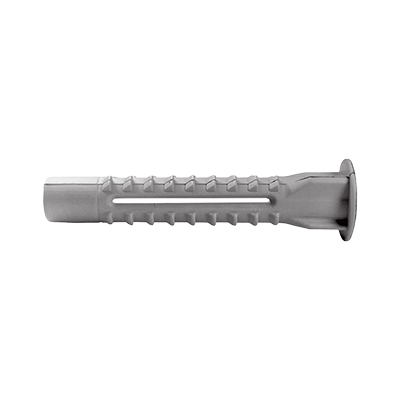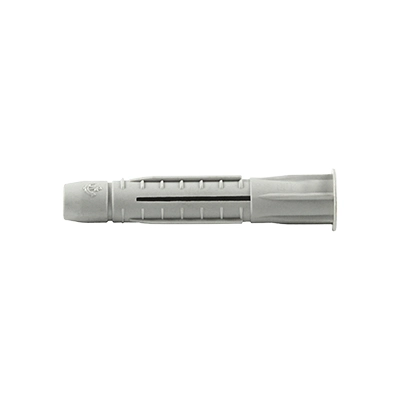

Conventional bushing - A Nylon Bushings
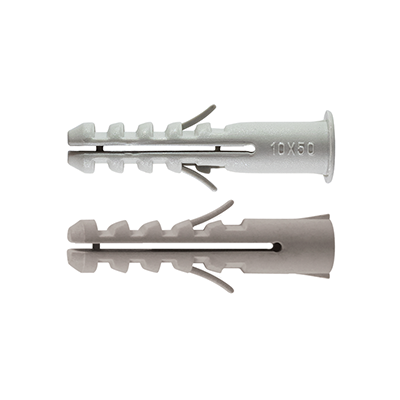
Conventional bushing with and without ring (flap).
FEATURES AND ADVANTAGES
- Made of polyamide (nylon).
- Excellent tensile strength, high durability, does not dry out or break.
- It has fins to prevent it from spinning.
- Utilizado com parafusos tipo madeira, autoatarraxante e sextavado soberba.
MAIN APPLICATIONS
- Fixings in concrete and solid masonry in general.
- Instalações de armários leves, prateleiras, quadros, painéis etc.
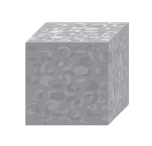
Concrete
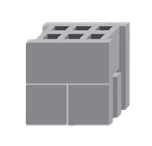
Concrete block
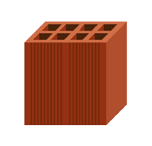
Ceramic block
Structural Block
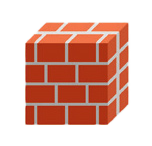
Solid brick
Stone
APPLICATION METHOD
Step: 1/5
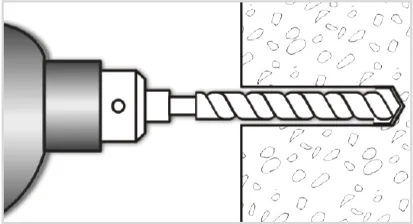
Drill a hole with a drill bit of the same diameter as the outer diameter of the bushing and the length indicated.
Step: 2/5
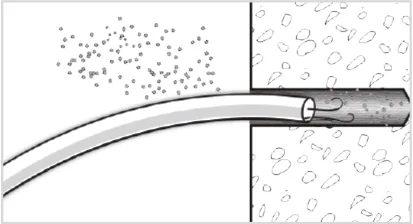
Clean the hole.
Step: 3/5
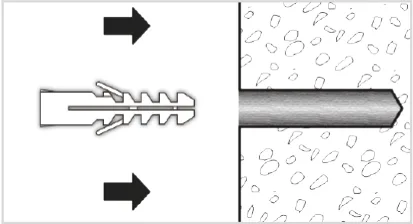
Insert the plug.
Step: 4/5
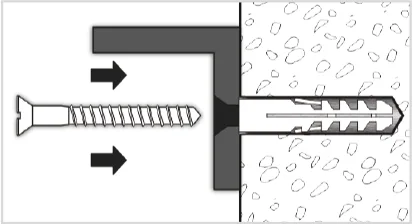
Adjust the component to be fixed and insert the screw of the corresponding diameter.
Step: 5/5
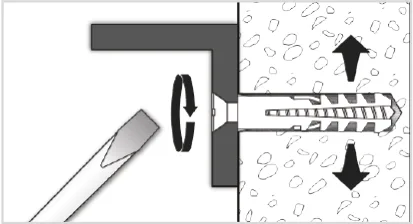
Give it a good squeeze.
TECHNICAL DATA
| Code | Plug dimensions (mm) | Hole (mm) | Screw | Tensile loads² (kgf) | |||||
|---|---|---|---|---|---|---|---|---|---|
| No flap | With flap | Outside diameter | Length (mm) | Diameter | Depth¹ | Diameter (mm) | Length³ (mm) | Permissible load² Solid masonry |
Permissible load² Concrete 20 MPa |
| A5 | - | 5 | 25 | 5 | 35 | 2,8 a 3,8 | 30 + tfix | 13 | 14 |
| A6 | AB6S | 6 | 30 | 6 | 40 | 3,5 a 4,8 | 35 + tfix | 12 | 32 |
| A8 | AB8S | 8 | 40 | 8 | 50 | 4,5 a 6,1 | 45 + tfix | 25 | 47 |
| A10 | AB10S | 10 | 50 | 10 | 60 | 6,0 a 8,0 | 55 + tfix | 49 | 65 |
| A12 | - | 12 | 60 | 12 | 70 | 8,0 a 10,0 | 65 + tfix | 50 | 109 |
(1) Profundidades mínimas.
(2) Carga permissível considerada em condições ideais de testes. Aplicado fator 7 de segurança na carga última, para cobertura de possíveis desvios, informado assim como carga sugerida.
(3) tfix = Espessura da peça a fixar.
Nota – Distância mínima entre as buchas deve respeitar 2 vezes o comprimento da bucha e 1 vez o comprimento da bucha para a borda.
As cargas podem variar de acordo com o material base e as condições de aplicação.
* Utilize parafusos autoatarraxante / rosca soberba
(2) Carga permissível considerada em condições ideais de testes. Aplicado fator 7 de segurança na carga última, para cobertura de possíveis desvios, informado assim como carga sugerida.
(3) tfix = Espessura da peça a fixar.
Nota – Distância mínima entre as buchas deve respeitar 2 vezes o comprimento da bucha e 1 vez o comprimento da bucha para a borda.
As cargas podem variar de acordo com o material base e as condições de aplicação.
* Utilize parafusos autoatarraxante / rosca soberba